No Assent, No Agreement: Establish Clear, Unambiguous Assent to Bind Consumers to Online Agreements
A clear, well-written terms of use agreement is essential for e-commerce sellers and online service providers seeking to manage the risk of litigation through provisions such as arbitration clauses and class action waivers.
However, even the best-drafted terms of use fail if users are not actually bound to them. Applying standard contract rules, courts look closely at whether users received clear notice of the terms and expressly agreed to them. In a recent decision, Sanchez v. Maggy London International Ltd., No. 3:25-cv-02107 (S.D. Cal. Nov. 6, 2025), the court held that an online retailer’s checkout design did not tie consumer action to an unambiguous manifestation of assent, requiring litigation in court rather than arbitration.
Background
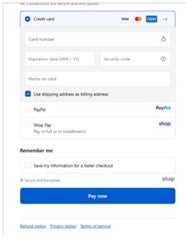
Online retailer Maggy London International Ltd. allegedly engaged in “phantom discount” practices on its website by listing product sales prices next to a strikethrough of a higher price, which had not been the “prevailing market price” in the 90 days prior. Consumers brought a class action under California’s false advertising and unfair competition laws. Maggy London moved to compel arbitration based on an arbitration clause in its terms of service. On the checkout page, links to the Terms of Service, Privacy Policy, and Refund Policy appeared beneath the “Pay Now” button and below the payment fields. Maggy London argued that these links were enough to bind buyers to the terms when they clicked “Pay Now.” The court denied the motion, finding the arbitration agreement unenforceable because the checkout interface did not secure clear, unambiguous agreement to the terms.
Threshold Question: Did the Terms Give Rise to an Enforceable Agreement?
Arbitration clauses in online terms can help reduce class action risk and defense costs. Under the Federal Arbitration Act, courts must compel arbitration when the claims fall within an enforceable arbitration agreement. The threshold question is whether a contract was formed: do the terms create a legally enforceable agreement?
Under California law, online terms are enforceable, subject to any substantive challenges, when two conditions are met. First, the site must give users reasonably conspicuous notice of the terms. Second, the user must take an action that clearly and unambiguously signals agreement to those terms.
Reasonably Conspicuous Notice
To evaluate whether Maggy London provided reasonably conspicuous notice, the court considered whether a reasonably prudent internet user would have seen the terms in the context of the transaction, taking into account the font, color, and placement of the hyperlinked “Terms of Service.” The text appeared in light blue and was underlined, indicating a hyperlink, and sat directly under the “Pay Now” button in a readable way. Therefore, the court concluded that the hyperlink provided the plaintiff with reasonably conspicuous notice of the terms.
Unambiguous Manifestation of Assent
The court next considered whether the plaintiff took some action, such as clicking the “Pay Now” button, that clearly demonstrated their agreement to the terms. This language was not sufficient to provide users with notice of the legal significance of pressing the “Pay Now” button. Of particular significance, the “Pay Now” button was not accompanied by a prompt or advisal indicating that completing the purchase meant agreeing to the terms. The bottom line is that “[a] link to the terms of service, absent more, is not enough.” Without explicit language connecting an action to assent, the court denied the motion to enforce the arbitration clause.
Key Takeaways
Earlier this year, the Ninth Circuit reached a similar decision in Chabolla v. ClassPass Inc. et al., 129 F.4th 1147 (9th Cir. 2025). The court reviewed each screen of the sign‑up flow and found the button labels or the accompanying language did not make it clear that the user’s action had legal significance. For example, the third screen stated “I agree to the Terms of Use and Privacy Policy” but was paired with a “Redeem now” button. Even taken together, the screens did not create unambiguous agreement to the terms due to each page’s deficiency.
The district court in Sanchez v. Maggy London cited Chabolla v. ClassPass for the principle that a conspicuous hyperlink to terms of use is insufficient to establish unambiguous manifestation of assent. In addition to being conspicuous, it is critical that the notice clearly identifies the specific action that binds the user. Operators of online platforms should look at each step of the user flow, not just the overall process. Each step should provide clear, conspicuous notice that proceeding signifies agreeing to the terms, and the notice should explicitly state which action has that effect.
[1] Image provided by United States District Court for the Southern District of California in the Order Denying Defendant’s Motion to Compel Arbitration.
Contacts




- Related Industries