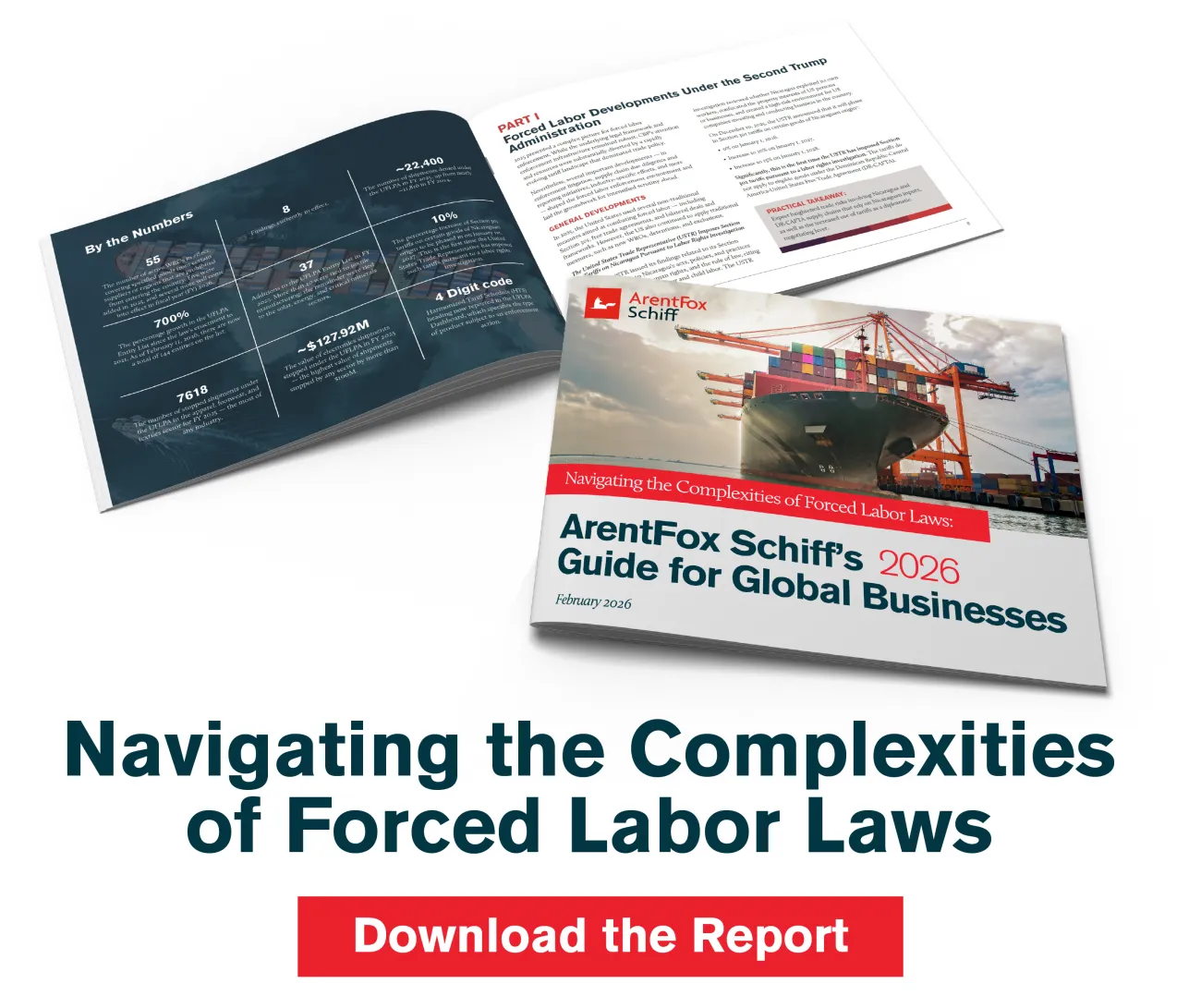
ArentFox Schiff’s 2026 Guide for Global Businesses
Navigating the Complexities of Forced Labor Laws

While enforcement may have taken a backseat to other trade priorities in 2025, this year may be poised to bring a swift and aggressive return to form, particularly if the tariff landscape begins to stabilize.
Preparing for Renewed Forced Labor Enforcement
Readiness and planning are essential. Be it detentions or supply chain disruptions, reputational harm or litigation exposure, the costs of inaction are simply too expensive to ignore.
Is your business ready for an anticipated resurgence of forced labor enforcement activity?
Our annual guide is here to help business leaders — importers, domestic purchasers, manufacturers, and compliance professionals — adequately prepare for what’s to come. Industry executives in fashion and retail, metals, clean energy, electronics (including batteries and drones), automotives, construction materials, agriculture, and others can expect to see an uptick in enforcement in 2026.
This edition provides an overview of the forced labor enforcement developments that shaped 2025 and offers predictions for what’s to come, as well as practical steps to mitigate risks and succeed in today’s challenging trade environment.

Key Forced Labor Enforcement Takeaways for 2026
- Expect a focus on enforcement to return — with potentially significant impacts on the private sector. Though the Uyghur Forced Labor Prevention Act (UFLPA) and general forced labor enforcement slowed in 2025, companies should not mistake this lull as a policy retreat. After all, the US Customs and Border Protection’s (CBP) underlying enforcement infrastructure remains intact, the interagency Forced Labor Enforcement Task Force (FLETF) has signaled its intent to broaden the scope of targeted industries and heighten scrutiny of indirect supply chain links, Congressional oversight remains robust, and the US Department of Justice’s (DOJ) new focus on trade fraud could introduce new levels of risk for importers. Meanwhile, litigation, shareholder activism, buyer scrutiny, and reputational impacts continue to add new risk dimensions for companies whose supply chains touch high-risk regions or commodities.
- The United States will continue to use novel measures to combat forced labor, including Section 301, free trade agreements, and bilateral deals and frameworks. Tariffs in particular may be used as a negotiating tool: In 2025, a wave of trade deals and frameworks included labor commitments or considerations that aim to shift the enforcement burden to US trading partners.
- New industries (and geographies) will be put under the microscope. Regulators will continue to focus on automotive manufacturers, the electronics industry, critical minerals supply chains, and steel and aluminum processors. However, new targets are also emerging: electric vehicles (EVs) and their battery supply chains, pharmaceuticals, and medical devices. New Withhold Release Orders (WROs) and findings outside of China will also be issued.
- International enforcement coordination will pick up. Companies should anticipate increased information sharing among international customs authorities as allied nations implement or strengthen their own forced labor import restrictions — particularly under recent trade deals and frameworks. Consequently, organizations should plan to implement robust due diligence programs in other jurisdictions.
- Companies should be aware of pending US state forced labor laws. States continue to propose forced labor laws that limit the ability of companies to sell to state governments, which are the largest purchasers in many states. Companies should therefore prepare for potential new requirements in states like California.
- Technology will be key for both government enforcement targeting and importers’ supply chain due diligence efforts. We expect the government to increasingly leverage technology and data analysis to target priority sectors. At the same time, companies can use evolving technologies to assist with forced labor diligence.
Additional research and writing from Fernando Ramírez, project assistant in ArentFox Schiff’s Washington, DC, office.
Contacts









- Related Industries
- Related Practices